
 Türkçe
 English
 Deutsch
 Español
 Français
 Italiano
 Português
 عربي
 Polski
 Čeština
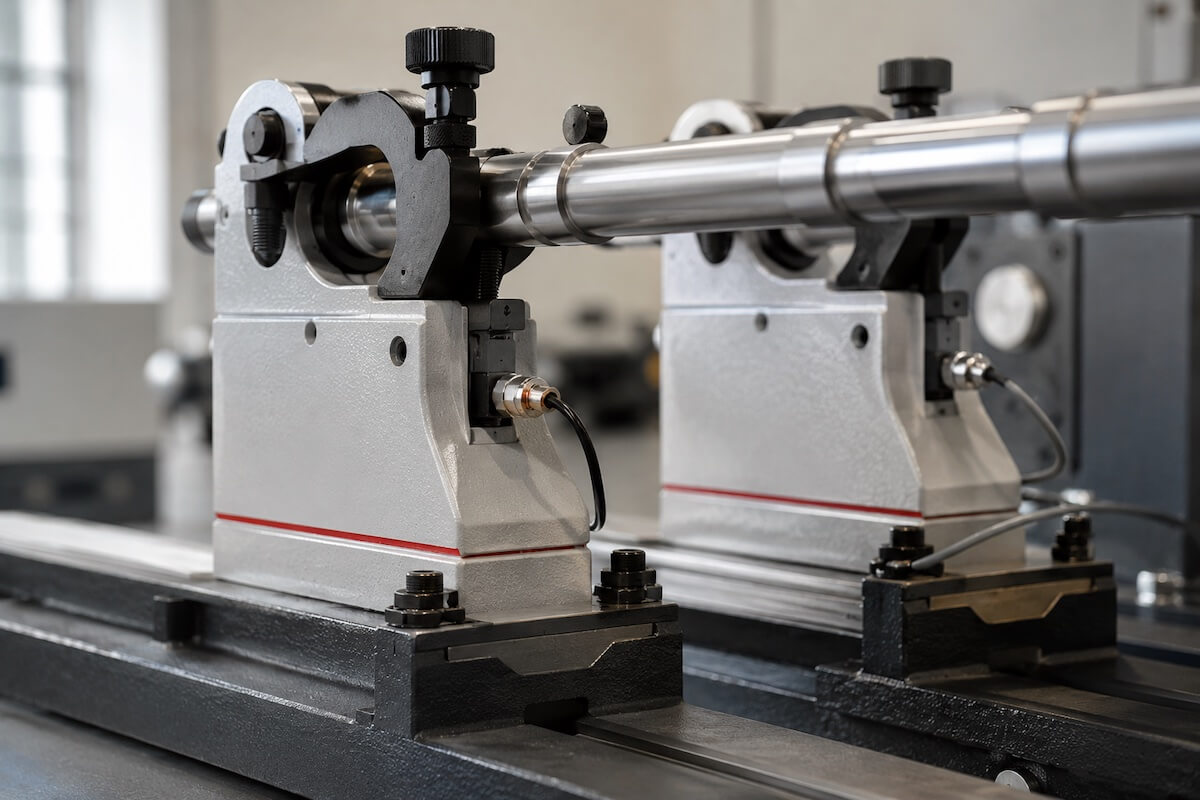
Hard-Bearing or Soft-Bearing? Choosing the Bearing Type of a Balancing Machine
In a balancing machine investment there is a question that is just as decisive as capacity and speed range, yet is usually left until last: should the machine be hard-bearing or soft-bearing? This choice determines the measuring principle, the calibration effort and the residual unbalance level that can be reached. Neither type is "better" than the other; they are two different approaches designed for different jobs.
The basic difference: below or above the resonance region
The bearing and support system of a balancing machine forms a spring-mass system together with the rotor, and that system has a natural frequency (resonance speed). What separates the two bearing types is where the measurement is taken relative to this resonance.
- Hard-bearing machines are built with rigid pedestals; the natural frequency of the support system lies far above the balancing speed. Measurement takes place below resonance. The rotor barely moves in its bearings; the centrifugal force generated by the unbalance is measured directly by the transducers.
- Soft-bearing machines have pedestals mounted on flexible springs and therefore a low natural frequency. Measurement takes place above resonance. The unbalance lets the pedestals swing freely, and this displacement is what gets measured.
Hard-bearing machines: permanent calibration, fast setup
With rigid pedestals, the relationship between the measured force and the unbalance is linear and largely independent of rotor mass across the working range of the machine. The machine is therefore calibrated once, and that calibration is permanent. For a new rotor, the operator simply enters geometric data such as bearing distances and correction planes into the iBalancer balancing software; the machine delivers the correction value on the first run.
Where it pays off
- Job shops and service centers handling a wide variety of rotors: no trial-weight run is needed for each part.
- Lines working across a wide weight range: small and large rotors are accepted without recalibration.
This is why general-purpose horizontal balancing machines, such as the H-IRB-50 designed for small and medium-weight rotors, are considered the first choice in plants with high part variety. Calibration is verified periodically with a calibration rotor and calibration weights.
Soft-bearing machines: displacement-based sensitivity
On a soft-bearing machine, how far the pedestals swing depends not only on the unbalance but also on the mass and mass distribution of the rotor. The measuring system therefore has to be calibrated separately for each rotor type: from a second run with a known trial weight, the software computes the rotor-specific coefficients. In series production of the same part, calibration is done once and the stored setup is reused for the following parts.
Where it pays off
- Very low residual unbalance targets: flexible pedestals respond to even small unbalances with a clearly measurable motion.
- Light rotors: the centrifugal force they generate stays small, while displacement-based measurement still gives a strong signal.
- Low-variety, high-volume series production: a single calibration is spread across a large number of parts.
For light, disc-shaped parts such as fan impellers, pulleys and brake discs, vertical balancing machines come to the fore; the V-IVB-5, designed for small and light parts, is an example of this class.
Selection criteria
- Part variety and batch size: High variety and low quantities point to hard-bearing; low variety and high quantities point to soft-bearing. The smaller the batch, the larger the share taken up by the trial-weight run.
- Target balance quality grade: As the G grade set according to ISO 21940-11 tightens, it becomes critical that the measuring system produces a reliable signal at that level. The minimum residual unbalance the machine can achieve is verified under ISO 2953.
- Operator skill: Trial-weight calibration demands manual skill and attention; geometry entry gives reliable results with less experience.
- Installation and foundation: In force measurement, the rigidity of the machine bed and the floor matters. Flexibly supported systems partly isolate floor effects, but are more sensitive to low-frequency vibration in the surroundings.
- Speed range: On a hard-bearing machine the operating speed must stay below the support resonance; on a soft-bearing machine it must rise sufficiently above the suspension resonance.
What a wrong choice costs
When a job shop handling a wide variety of parts buys a soft-bearing machine, repeating the calibration on every part drags down productivity. A manufacturer aiming for tight tolerances on very light rotors, on the other hand, may fail to reach the target on a hard-bearing machine because the measuring signal is weak. In both cases the problem is the same: the bearing type does not match the work. On existing machines, the measuring electronics and software can be renewed through a balancing machine system modernization; the bearing type, however, cannot be changed, which is why the decision has to be made correctly from the start.
Decision summary
- Service shop, wide rotor variety, small batches, changing operator staff: hard-bearing.
- Low variety, high volume, light rotors, very low residual unbalance target: soft-bearing.
- Mixed profile: the part list, target G grade and speed range are assessed together; MBS Balance carries out this assessment on sample parts.
Once the weight range of the parts, the quantity distribution and the tolerance target are clarified before purchase, the right bearing type emerges on its own.