
 Türkçe
 English
 Deutsch
 Español
 Français
 Italiano
 Português
 عربي
 Polski
 Čeština
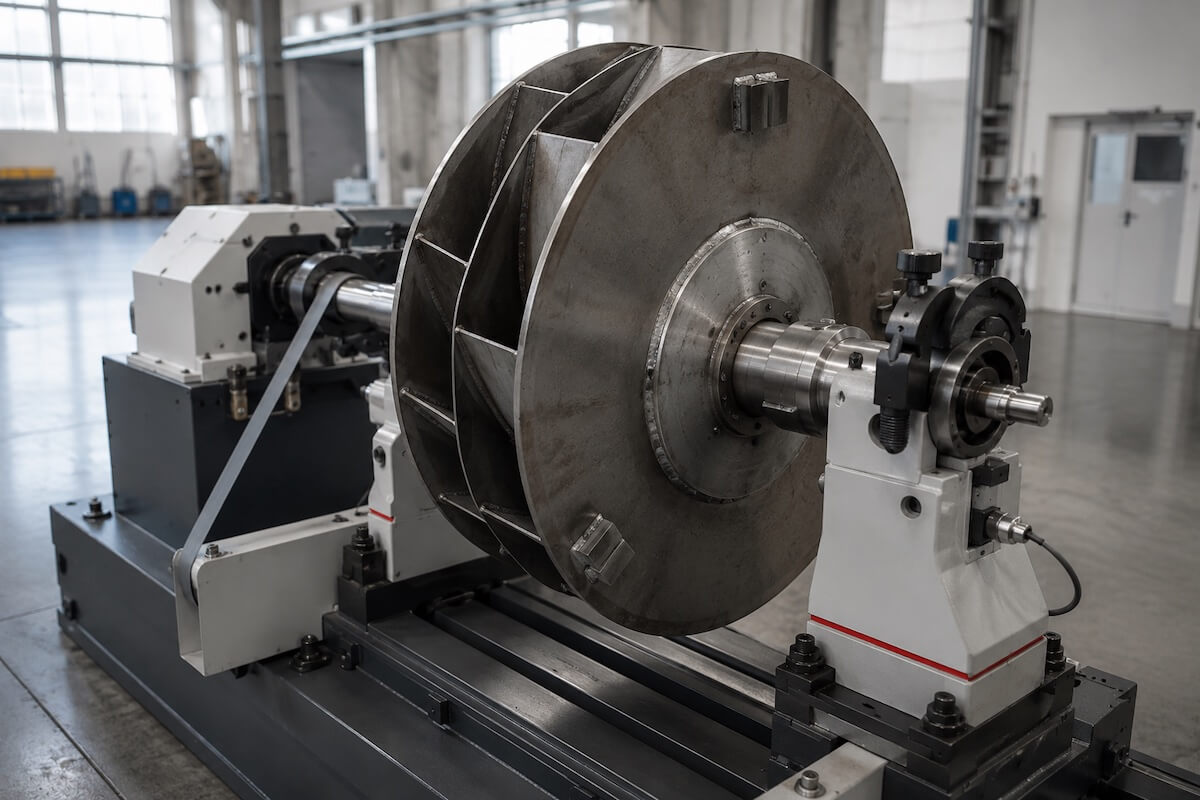
Balancing Fan and Blower Rotors: Tolerance and Machine Selection
Fan and blower rotors are among the components that generate the most vibration complaints in industrial plants. The blades are in constant contact with dust, moisture, chemical vapors and heat; a rotor that leaves the factory balanced loses that balance over time. This article covers diagnosis, the plane decision, correction method, tolerance and machine selection for fan balancing.
Why do fan rotors go out of balance so often?
A fan impeller is in direct contact with the fluid it moves; every gram that builds up on or wears away from a blade turns into a larger unbalance as the rotor diameter grows. The causes seen most often in the field:
- Dust and dirt build-up: Material deposited on the back of the blades is not evenly distributed; when part of it breaks away, the unbalance jumps suddenly.
- Wear and corrosion: In fans carrying abrasive particles, the blade edges thin asymmetrically; corrosion spreads mass loss at random.
- Blade deformation: A blade bent by impact, excessive temperature or overspeed shifts the center of mass and the aerodynamic load.
- Mass change after repair and welding: Blade replacement, crack welding, hub replacement or repainting alters the mass distribution; a repaired rotor should not be returned to service without being balanced.
Symptoms of fan unbalance
Unbalance shows itself as radial vibration at the rotor's rotational frequency, increasing with speed. Typical signs: vibration at the bearings that rises over time, a speed-dependent hum, short bearing life and recurring bearing failures, cracks in the casing, frame and ducting, loosening bolts and signs of fatigue.
Conditions mistaken for unbalance
Not every rise in vibration is unbalance; the following possibilities should be ruled out first:
- Misalignment: Coupling misalignment produces pronounced vibration at multiples of the rotational frequency and in the axial direction.
- Looseness: Looseness in a bearing cap, a foundation bolt or the hub clamping generates a large number of harmonics in the spectrum.
- Bearing damage: Rolling bearing faults appear as high-frequency components independent of the rotational frequency.
- Resonance: If the fan speed is close to the natural frequency of the frame or duct system, even a small unbalance produces large amplitudes; the remedy is structural stiffening or a change of speed.
The reliable way to make this distinction is to measure vibration together with the phase angle. Measuring software such as iBalancer balancing software displays the unbalance vector with its phase information and calculates the position and amount of the correction weight.
One plane or two?
The decision depends on rotor geometry and operating speed. Narrow, disc-type rotors whose width is small relative to their diameter (single-inlet radial impellers, thin axial propellers) are mostly balanced in a single plane at low and medium speeds. In wide or long rotors (double-inlet centrifugal impellers, axial fans with long hubs, several impellers on one shaft) the unbalance is distributed along the rotor and correction in two planes is required; a single-plane correction can reduce vibration at one bearing while increasing it at the other. The basic criteria are the diameter-to-width ratio and the speed: the wider the rotor and the higher the speed, the greater the effect of couple unbalance. In doubtful cases it is safer to measure in two planes and decide from the result.
Correction methods and tolerance selection
Add weight or remove material?
Correction is made either by adding weight (welded plate, riveted, bolted or clip-on weights) or by removing material (grinding, drilling). On fan blades the preference is generally to add weight: grinding or drilling a thin sheet-metal blade reduces its strength, disturbs the flow surface and creates a starting point for corrosion. The weight should be applied to the back plate, the hub or the back of the blade so as not to affect the flow; with welded weights, the heat input can distort the sheet, so the rotor should be measured again after welding. On aluminum and plastic propellers, bolted or clip-on weights are used; material removal is suitable only on cast rotors with a thick hub or a machining allowance left for the purpose.
The logic of ISO 21940-11 quality grades
The balance tolerance for rigid rotors is defined in ISO 21940-11 by G quality grades. The grade expresses the permissible circumferential velocity of the rotor's center of mass; the permissible residual unbalance is calculated from the rotor mass and the operating speed. Within the same grade, a heavy rotor is allowed more residual unbalance, while a high-speed rotor requires a tighter tolerance. The standard recommends grades for typical rotor types, fans included; the appropriate grade should be chosen according to the fan's type, speed and place of use, and the manufacturer's specification should take precedence where one exists.
In the field or on the machine? Choosing the machine
For large or permanently installed rotors such as flue gas, cooling tower and process fans, removal is costly and risky; balancing is done with the fan running in its own bearings. A portable instrument reads vibration and phase at the bearings, a trial weight gives the influence coefficient, and the correction weight is applied. The on-site balancing service balances the installed system as a whole; but because the result is affected by the behavior of the bearings and frame, it is not as repeatable as a measurement on a balancing machine.
In production and repair shops, the rotor is mounted on the machine on its shaft or on a mandrel; the machine measurement gives the rotor's own residual unbalance, which can be compared directly with the ISO 21940-11 tolerance. For impellers mounted on a shaft and shaft-impeller assemblies, horizontal balancing machines are the standard solution; the HIRB-100 horizontal balancing machine is one of the models that can be considered for two-plane fan rotor balancing. Shaftless disc-type impellers clamped at the hub can be balanced in a single plane on vertical balancing machines. For shops without a machine of their own, rotors are measured and corrected under the horizontal balancing service.